How to Manage Family Accounts in a BJJ Gym: Kids, Parents, and Shared Access

Mansour

Why Family Management Is Different from Member Management
Most gym management tools treat every member as an independent individual. A child gets a profile, a parent gets a profile, and there's no structured relationship between them.
This creates real problems in a BJJ academy:
- Payment confusion. Who's responsible for the child's subscription? If a parent pays for three kids, is that visible in one place?
- Communication gaps. When the coach sends a class update, does it reach the parent or only the child's unused email?
- Progress visibility. Parents want to know how often their child attends, what belt they're on, and when the next promotion might happen. Without a linked system, they have to ask and coaches have to look it up manually every time.
- Separated families. When parents don't live together, only one typically has access to updates. The other parent is left out, which creates tension that often falls on the gym to manage.
These aren't technical edge cases. They're the daily reality of running a kids BJJ program at scale.
What a Structured Family System Looks Like
A well-designed family account system in a BJJ gym should handle three things:
1. Parent-Child Linking
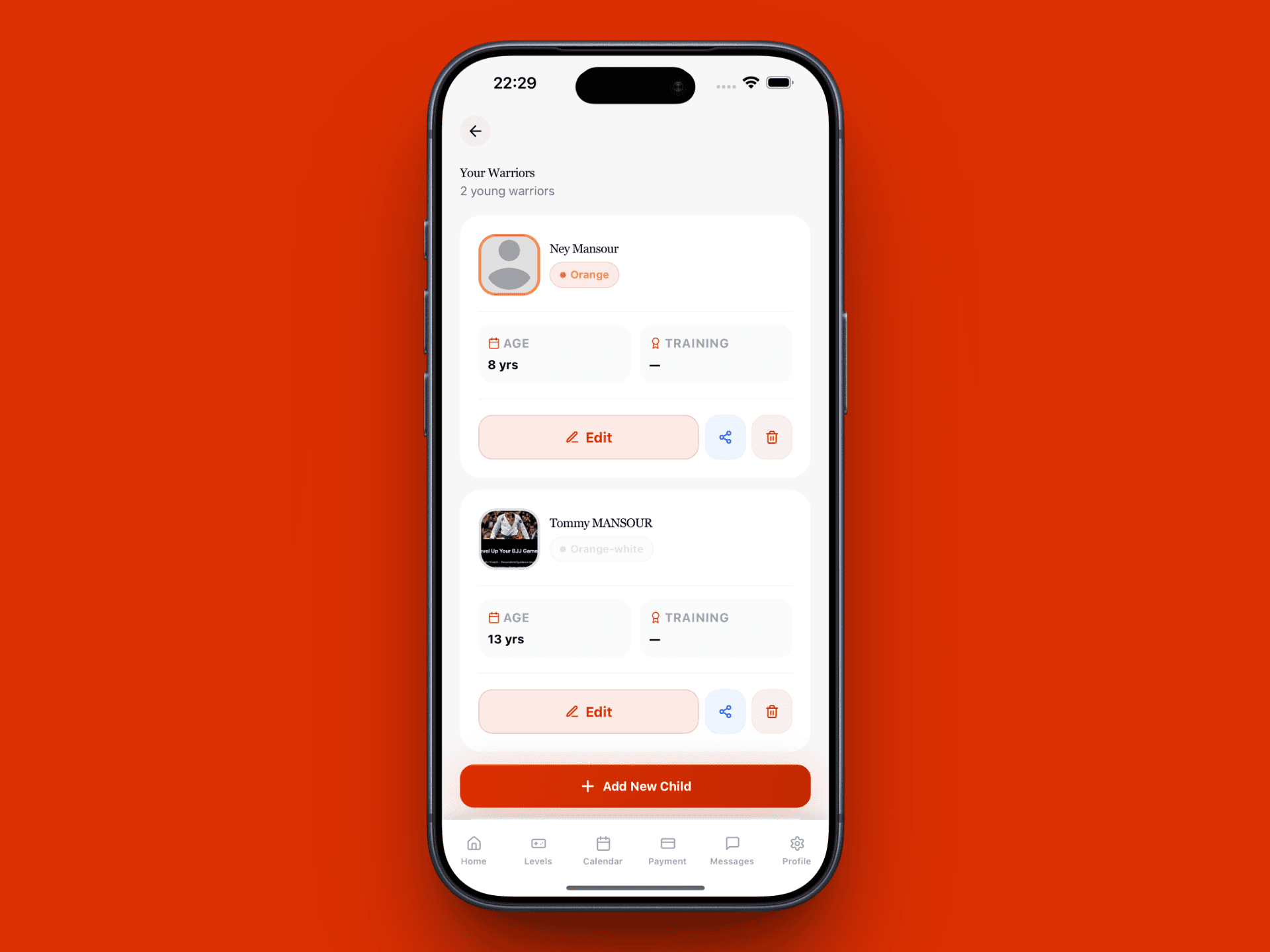
Each child account should be connected to a parent profile. The parent should be able to:
- View all their children from a single dashboard
- Switch between child profiles without logging in and out
- See attendance history, belt status, and class participation for each child
This eliminates the constant back-and-forth between parents and coaches about basic information.
2. Multi-Parent Access
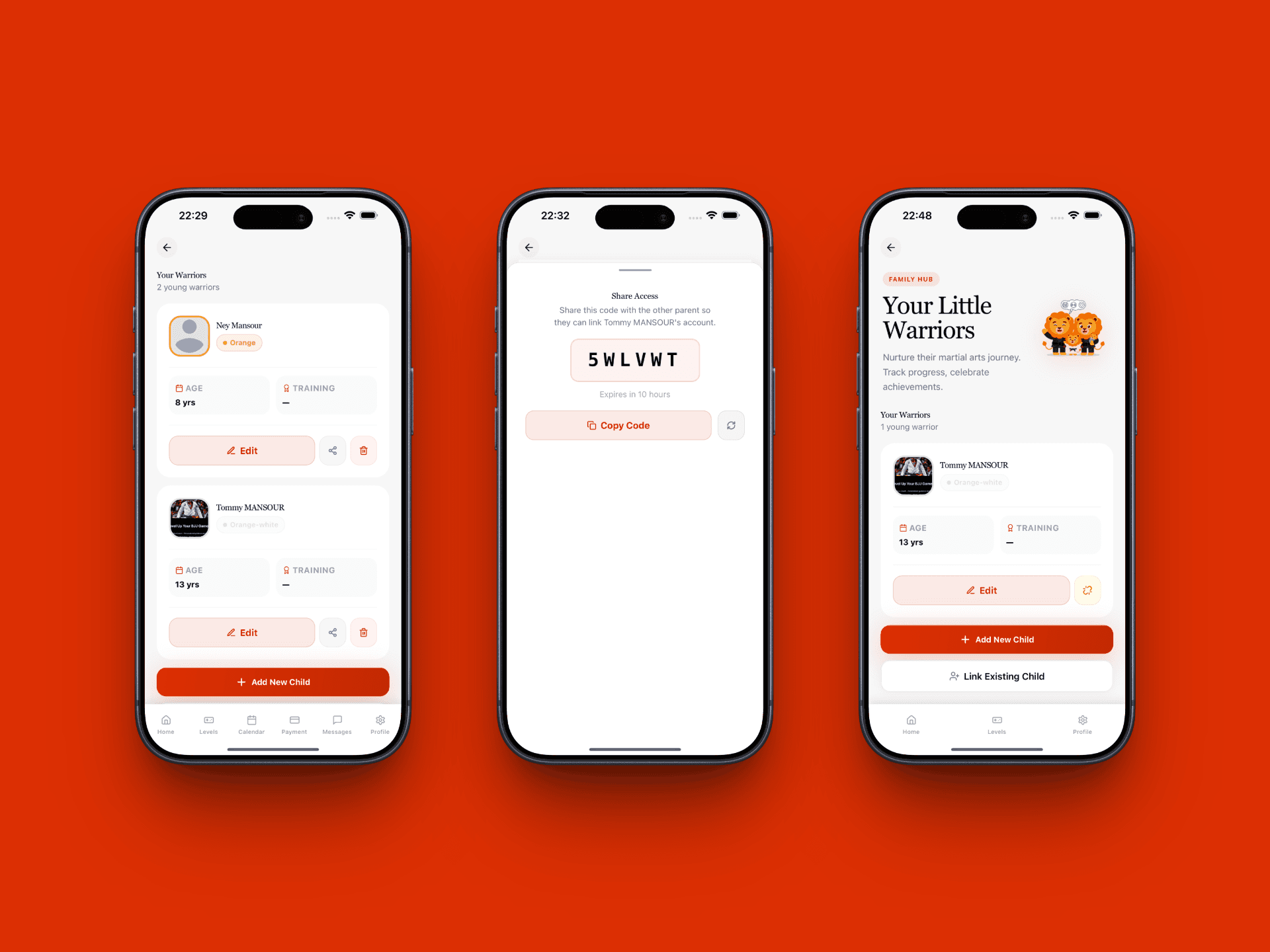
Families come in all shapes. Separated parents, step-parents, and guardians all need some level of access to a child's training information.
A robust system allows multiple parents to be linked to the same child account. The first parent creates the child profile and can generate a share code a short, time-limited code that the second parent enters on their own device to link the same child to their account.
This means:
- Both parents see the child in their account switcher
- Both can view attendance, belt progress, and class schedules
- The primary parent retains full control (including the ability to delete the account)
- The secondary parent can unlink themselves at any time without affecting the child's data
No phone calls to the front desk. No awkward conversations between parents. No admin involvement required.
3. Multi-Child Management
Families with multiple children training should be able to manage all of them from a single parent account. Each child has their own profile, their own belt progression, and their own attendance history but the parent sees everything in one place.
This also simplifies payments: instead of tracking separate subscriptions per child, the gym can manage family billing through the parent account.
How Family Accounts Affect Retention
Retention in kids BJJ programs is driven primarily by parent satisfaction, not child enthusiasm. A seven-year-old rarely decides on their own to quit but a parent who feels uninformed, frustrated with billing, or disconnected from their child's progress will pull them out.
Family account systems improve retention by:
- Reducing friction. Parents who can check attendance and progress on their phone don't need to ask coaches during class which means less interruption for everyone.
- Keeping both parents engaged. In separated families, the parent who doesn't bring the child to class often disengages entirely. Giving them access to the child's profile keeps them involved and less likely to question the value of continued enrollment.
The Coach's Perspective: Why This Matters Operationally
For coaches and gym owners, family account management isn't just a parent-facing feature. It directly reduces administrative workload.
Without structured family linking:
- Coaches spend time relaying attendance information to parents after class
- Front desk staff manually track which parent paid for which child
- Promotion discussions require looking up individual records across multiple systems
With a connected system:
- Parents self-serve on the information they need
- Payment visibility is automatic
- Bulk student imports can automatically detect and link family members based on guardian information
The time saved per interaction is small. Multiplied across dozens of families and hundreds of interactions per month, it fundamentally changes how much time coaches spend on administration versus coaching.
Common Approaches (and Where They Fall Short)
WhatsApp groups: Fast and familiar, but impossible to structure. Parents ask the same questions repeatedly, messages get buried, and there's no separation between communication and data.
Spreadsheets: Flexible for tracking, but they don't notify parents, don't support account switching, and break down as soon as multiple people need to edit them.
Generic gym software: Most fitness management platforms support individual memberships. Very few support parent-child linking, multi-parent access, or BJJ-specific features like belt progressiontracking and stripe history.
Paper sign-in sheets: Still common in smaller academies. They capture presence but provide zero visibility to parents and require manual data entry to be useful for anything beyond head counts.
When BJJ Gyms Make the Shift
The tipping point is usually not a single event it's a pattern.
A parent asks for the third time this month how many classes their child attended. A separated father calls the front desk because he can't see his daughter's belt promotion. A family with four kids gets billed incorrectly because their records are spread across three different spreadsheets.
At this stage, gym owners recognize that the problem isn't effort — it's structure. The tools they're using weren't designed for the relationships that define a BJJ academy.
Some academies build internal workarounds. Others look for purpose-built solutions like Kombat Evolve, which is designed around the realities of BJJ gym operations including family account linking, multi-parent access through share codes, kids belt systems, attendance-based promotion tracking, and parent-facing dashboards that provide visibility without requiring coach intervention.
Conclusion
Managing family accounts in a BJJ gym is not an administrative convenience it's an operational necessity as kids programs grow.
The gyms that handle this well retain more families, reduce coach burnout, and create an environment where parents feel informed and involved. The gyms that don't eventually hit a ceiling where growth creates more problems than revenue.
For academy owners building for the long term, family management deserves the same level of attention as curriculum design and belt standards. Because the families who feel connected to their child's journey are the ones who stay.